Showing 2 of 2 Results

Spotlight Books

decorative-image
11/03/2025

November 3 - 8 is First-Gen Week. For the month of November, UVM Libraries honors UVM authors who were the first in their families to attend college. Did you know that Dr. Tromp is a first-generation college student? Visit the Howe Library Lobby display to find these books, plus many more.  


Cover Art Fear, loathing, and Victorian xenophobia by Tromp, Marlene (Editor), Bachman, Maria (Editor), Kaufman, Heidi (Editor) 

In this groundbreaking collection, scholars explore Victorian xenophobia as a rhetorical strategy that transforms "foreign" people, bodies, and objects into perceived invaders with the dangerous power to alter the social fabric of the nation and the identity of the English. Essays in the collected edition look across the cultural landscape of the nineteenth century to trace the myriad tensions that gave rise to fear and loathing of immigrants, aliens, and ethnic/racial/religious others. This volume introduces new ways of reading the fear and loathing of all that was foreign in nineteenth-century British culture, and, in doing so, it captures nuances that often fall beyond the scope of current theoretical models. "Xenophobia" not only offers a distinctive theoretical lens through which to read the nineteenth century; it also advances and enriches our understanding of other critical approaches to the study of difference. Bringing together scholarship from art history, history, literary studies, cultural studies, women's studies, Jewish studies, and postcolonial studies, Fear, Loathing, and Victorian Xenophobia seeks to open a rich and provocative dialogue on the global dimensions of xenophobia during the nineteenth century.
 

Cover Art Hydrologic effects of a changing forest landscape by National Research Council (U.S.). Committee on Hydrologic Impacts of Forest Management. 

Of all the outputs of forests, water may be the most important. Streamflow from forests provides two-thirds of the nation's clean water supply. Removing forest cover accelerates the rate that precipitation becomes streamflow; therefore, in some areas, cutting trees causes a temporary increase in the volume of water flowing downstream. This effect has spurred political pressure to cut trees to increase water supply, especially in western states where population is rising. However, cutting trees for water gains is not sustainable: increases in flow rate and volume are typically short-lived, and the practice can ultimately degrade water quality and increase vulnerability to flooding. Forest hydrology, the study of how water flows through forests, can help illuminate the connections between forests and water, but it must advance if it is to deal with today's complexities, including climate change, wildfires, and changing patterns of development and ownership. This book identifies actions that scientists, forest and water managers, and citizens can take to help sustain water resources from forests.
 

Cover Art Out of the closets & into the courts legal opportunity structure and gay rights litigation by Andersen, Ellen Ann 

Over the past 30 years, the gay rights movement has moved from the margins to the center of American politics, sparking debate from bedroom to boardroom to battlefield. Out of the Closets and into the Courts analyzes the most recent gay rights cases, and explores the complex relationship between litigation and social change. Ellen Andersen describes what happens when these cases--many overseen by the Lambda Legal Defense Fund, the nation's oldest and largest gay rights defense firm--enter the courtroom, and explains why they have met with mixed success. Out of the Closets and into the Courts explores both the promise and the limits of using legal mobilization to effect social change. Crossing disciplinary boundaries, Ellen Andersen draws on the accumulated knowledge of political science, law, and sociology to explain the origins and outcomes of gay rights litigation. The resulting book is essential reading for anyone interested in gay rights, legal change, and social movements.


Cover Art Beyond filial piety : rethinking aging and caregiving in contemporary East Asian societies by Shea, Jeanne (Editor); Moore, Katrina (Editor); Zhang, Hong (Editor) 

Publication Date: 2022-04-08
Known for a tradition of Confucian filial piety, East Asian societies have some of the oldest and most rapidly aging populations on earth. Today these societies are experiencing unprecedented social challenges to the filial tradition of adult children caring for aging parents at home. Marshalling mixed methods data, this volume explores the complexities of aging and caregiving in contemporary East Asia. Questioning romantic visions of a senior's paradise, chapters examine emerging cultural meanings of and social responses to population aging, including caregiving both for and by the elderly. Themes include traditional ideals versus contemporary realities, the role of the state, patterns of familial and non-familial care, social stratification, and intersections of caregiving and death. Drawing on ethnographic, demographic, policy, archival, and media data, the authors trace both common patterns and diverging trends across China, Hong Kong, Taiwan, Singapore, Japan, and Korea.
 

Cover Art Urban natures : living the more-than-human city by Edwards, Ferne (Editor); Popartan, Lucia Alexandra(Editor); Pettersen, Ida Nilstad (Editor) 

Efforts to create greener urban spaces have historically taken many forms, often disorganized and undisciplined. Recently, however, the push towards greener cities has evolved into a more cohesive movement. Drawing from multidisciplinary case studies, Urban Natures examines the possibilities of an ethical lively multi-species city with the understanding that humanity's relationship to nature is politically constructed. Covering a wide range of sectors, cities, and urban spaces, as well as topics ranging from edible cities to issues of power, and more-than-human methodologies, this volume pushes our imagination of a green urban future.


Cover Art How stories heal : writing our way to meaning & wholeness in the academy by Nash, Robert J. 

It is time for academics to embrace the fact that nothing is more appealing to readers - especially to our students - than personal stories with meaning-making implications that can touch all lives. No matter the age or stage in life, the personal or collective identity, everyone deals with meaning-making issues that challenge them - and others - throughout their lifetimes. And everyone we know finds that when encouraged to write their stories in the academy, they find meaning, wholeness, and healing. How Stories Heal illustrates the value of personal narrative writing. Referring to this type of writing as the «turn to the subjective I» or to «me-search research», this is a book about Scholarly Personal Narrative (SPN) writing, actually written in an SPN style. This book will satisfy a huge need in higher education and scholarship, particularly for students who are writing undergraduate and graduate theses and doctoral dissertations; and also for junior and senior faculty who are looking to construct alternative forms of scholarship for publication.


Cover Art Marine biodiversity of Costa Rica, Central America by Wehrtmann, Ingo S. (Editor); Cortés, Jorge (Editor) 

Life began in the sea, and even today most of the deep diversity of the planet is marine. This is often forgotten, especially in tropical countries like Costa Rica, renowned for their rain forests and the multitude of life forms found therein. Thus this book focusing on marine diversity of Costa Rica is particularly welcome. How many marine species are there in Costa Rica? The authors report a total of 6,777 species, or 3. 5% of the world's total. Yet the vast majority of marine species have yet to be formally described. Recent estimates of the numbers of species on coral reefs range from 1-9 million, so that the true number of marine species in Costa Rica is certainly far higher. In some groups the numbers are likely to be vastly higher because to date they have been so little studied. Only one species of nematode is reported, despite the fact that it has been said that nematodes are the most diverse of all marine groups. In better studied groups such as mollusks and crustaceans, reported numbers are in the thousands, but even in these groups many species remain to be described. Indeed the task of describing marine species is daunting - if there really are about 9 million marine species and Costa Rica has 3. 5% of them, then the total number would be over 300,000. Clearly, so much remains to be done that new approaches are needed. Genetic methods have en- mous promise in this regard.


Cover Art Will work for food : labor across the food chain by Mares, Teresa M.; Minkoff-Zern, Laura-Anne 

Food consumers are demanding a healthier and more sustainable food system. Yet labor is rarely part of the discussion. In Will Work for Food, Laura-Anne Minkoff-Zern and Teresa Mares chronicle labor across the food chain, connecting the entire food system--from fields to stores, restaurants, home kitchens, and even garbage dumps. Using a political economy framework, the authors argue that improving labor standards and building solidarity among frontline workers across sectors is necessary for creating a more just food system. What would it take, they ask, to move toward a food system that is devoid of human exploitation? Combining insights from food systems and labor justice scholarship with actionable recommendations for policy makers, the book is a call to action for labor activists, food studies students and scholars, and anyone interested in food justice.


Cover Art Music education on the verge : stories of pandemic teaching and transformative change by Lewis, Judy (Editor, Contribution by); Maas, Andrea (Editor, Contribution by) 

Music Education on the Verge is a collection of narratives by music teacher-educators describing how they responded to the disruption of the COVID-19 pandemic. Each chapter offers examples of innovative music pedagogy that can be adapted and applied by music educators and music teacher educators with their students.


Cover Art Sustainable wellbeing futures a research and action agenda for ecological economics 

Climate disruption, overpopulation, biodiversity loss, the threats of financial collapse, large-scale damage to our natural and social environments and eroding democracy are all becoming critically important concerns. The editors of this timely book assert that these problems are not separate, but all stem from our overreliance on an out-dated approach to economics that puts growth of production and consumption above all else. Ecological economics can help create the future that most people want - a future that iss94 prosperous, just, equitable and sustainable. This forward-thinking book lays out an alternative approach that places the sustainable wellbeing of humans and the rest of nature as the overarching goal. Each of the book's chapters, written by a diverse collection of scholars and practitioners, outlines a research and action agenda for how this future can look and possible actions for its realization. Sustainable Wellbeing Futures will be of value to academics and students researching environmental and ecological economics, as well as individuals interested in gaining a greater understanding of the concept of a wellbeing future and how we might act to achieve it.

Cover Art Code choice in the language classroom by Levine-West, Glenn 

Language Classroom argues that the foreign language classroom is and should be regarded as a multilingual community of practice rather than as a perpetually deficient imitator of an exclusive second-language environment. From a sociocultural and ecological perspective, Levine guides the reader through a theoretical, empirical, and pedagogical treatment of the important roles of the first language, and of code-switching practices, in the language classroom. Intended for SLA researchers, language teachers, language program directors, and graduate students of foreign languages and literatures, the book develops a framework for thinking about all aspects of code choice in the language classroom and offers concrete proposals for designing and carrying out instruction in a multilingual classroom community of practice.


Cover Art Teaching old logs new tricks : more absurdities and realities of education by Giangreco, Michael F. 

"Insightful and provocative humor! The cartoons spark smiles and a bit of reflection. Used in workshops and seminars, they initiate laughter. But more important, they prompt conversation."
—Jane Goldoski, Staff Development Specialist

"The cartoons are great! Michael Giangreco has done it again with his third book of right-on-target cartoons that make their points better and faster than most lectures."
—Irene R. McEwen, Professor
University of Oklahoma


Cover Art Flavor and soul : Italian America at its African American edge by Gennari, John 

In the United States, African American and Italian cultures have been intertwined for more than a hundred years. From as early as nineteenth-century African American opera star Thomas Bowers--"The Colored Mario"--All the way to hip-hop entrepreneur Puff Daddy dubbing himself "the Black Sinatra," the affinity between black and Italian cultures runs deep and wide. Once you start looking, you'll find these connections everywhere. Sinatra croons bel canto over the limousine swing of the Count Basie band. Snoop Dogg deftly tosses off the line "I'm Lucky Luciano 'bout to sing soprano." Like the Brooklyn pizzeria and candy store in Spike Lee's Do the Right Thing and Jungle Fever, or the basketball sidelines where Italian American coaches Rick Pitino and John Calipari mix it up with their African American players, black/Italian connections are a thing to behold and to investigate. John Gennari spotlights this affinity, calling it "the edge"--now smooth, sometimes serrated--between Italian American and African American culture. He argues that the edge is a space of mutual emulation and suspicion, a joyous cultural meeting sometimes darkened by violent collision. Through studies of music and sound, film and media, sports and foodways, Gennari shows how an Afro-Italian sensibility has nourished and vitalized American culture writ large, even as Italian Americans and African Americans have fought each other for urban space, recognition of overlapping histories of suffering and exclusion, and political and personal rispetto.
 

Cover Art Reclaim your challenging classroom : relationship-based behavior management by Harris, Alene H. 

Students in classrooms with teachers who excel at behavior management tend to be more engaged, less disruptive, and achieve better academic outcomes. Furthermore, effective behavior management practices are seen as a key to achieving the goal of inclusive education. Teaching is a stressful job, and no struggle causes greater stress to general education and special education teachers than student misbehavior. Creating a New Beginning helps teachers-both new and veteran-who are struggling with classroom management, with an emphasis on classrooms that have one or more students with an emotional/behavioral disorder (EBD). Even veteran teachers who have a student with EBD included in the classroom for the first time may find themselves struggling. Teachers who work through the materials in the book will develop effective classroom management skills, which will result in improved teacher-student relationships, increased time to teach and learn, increased student academic learning, and greater teacher satisfaction in teaching. This last will contribute to reduced teacher attrition. With the increased diversity of today's students and with the identified links between teacher burnout and classroom management, the need for this book is great, and will only increase.
 

Cover Art Free Fall/Caida LIbre by Escaja, Tina; Eisner, Mark (Translator) 

In awarding the book-length poem Caída Libre (Free Fall) the Government of the Canary Islands' prestigious 2003 Dulce María Loynaz International Poetry Prize, the jury highlighted the "authenticity and force in the language", reflecting the process of a pregnancy with a "hard, steeled language," a language, though, "not incisive, but very realistic and extraordinarily beautiful." "In a masterful form," the poem, "passes from the plane of the intimate to that of the almost-epic, using a figure not found commonly in poetry: the chronicle of a pregnancy." (Press notes from December 10th, 2003).But Caída Libre registers much more beyond that chronicle. Conception, delivery, and maternity unite in an epic of the derangement and celebration at the end of the millennium in New York City. And then shortly afterwards, the catastrophe of the Twin Towers with its agony and irreversible transformation of values: the fall of the West's formulation in the previous millennium. Caída Libre is a brilliant and fundamental book to understand ourselves in our current century, in its conflicts and atrocities, but also in its soundness and revelations. The importance of its read is amplified by its Hispanic perspective and gender, and this bilingual edition opens up its accessibility. The book is currently being taught at universities around the globe, and has been included in important critical studies.
 

Cover Art Foodways of the ancient Andes : transforming diet, cuisine, and society by Alfonso-Durruty, Marta P. (Editor); Blom, Deborah E. (Editor) 

Exploring the multiple social, ecological, cultural, and ontological dimensions of food in the Andean past, this book offers a diverse set of theoretical perspectives and methodological approaches that reveal the richness, sophistication, and ingenuity of Andean peoples. With 44 contributors from 10 countries, the studies presented in this volume employ new analytical methods, integrating different food data and interdisciplinary research to show how food impacts socio-political relationships and ontologies that are otherwise invisible in the archaeological record.


Cover Art Humanizing methodologies in educational research : centering non-dominant communities by Reyes, Cynthia C.; Haines, Shana J.; Clark/Keefe, Kelly 

This guide is for educational researchers interested in conducting ethically sound qualitative studies with diverse populations, including refugees, documented and undocumented immigrants, and people with disabilities. Through a description of a case study with refugee families, their children, school personnel, and liaisons, the authors highlight humanizing methods--a multidirectional and dynamic ethical compass with relationships at the center. Topics in the book include working within the limitations of Institutional Review Board (IRB) standards, using cultural and linguistic liaisons to communicate with research participants, and creating reciprocity with research participants and their families and communities. Through accessible real-world examples, the text covers the full arc of a project, from conceptualization, to navigating human subjects committees, to the complex task of representing ideas to academic and community-based audiences.
No Subjects
decorative-image
11/03/2025

November 3 - 8 is First-Gen Week. Check out these new books in our collection regarding the experience of being the first in a family to attend college. Visit the Howe Library Lobby display to find these books, plus books authored by first-gen UVM faculty and staff - including our President, Dr. Marlene Tromp! 


Cover Art Undocumented : a Dominican boy's odyssey from a homeless shelter to the Ivy League by Padilla Peralta, Dan-el 

Throughout his youth, Dan-el navigated ... two worlds: the rough streets of East Harlem, where he lived with his brother and his mother and tried to make friends, and the ultra-elite halls of a Manhattan private school, where he could immerse himself in a world of books and where he soon rose to the top of his class. From Collegiate, Dan-el went to Princeton, where he thrived, and where he made the momentous decision to come out as an undocumented student in a Wall Street Journal profile a few months before he gave the salutatorian's traditional address in Latin at his commencement.


Cover Art Every student has a story : personal narratives from first-generation college students 

This book is a compilation of essays by TRIO Student Support Services Students at Indiana University Purdue University Fort Wayne (IPFW). Inspired by Aquinas College's student publishing project, IPFW TRIO Student Support Services coordinated a semester long opportunity for TRIO students in the spring of 2016. Students were asked to participate in writing circles where they could tell their stories, hear other students' stories, and get feedback about how to write compelling essays about their life experiences.


Cover Art First gen : a memoir by Campoverdi, Alejandra 

Alejandra Campoverdi has been a child on welfare, a White House aide to President Obama, a Harvard graduate, a gang member's girlfriend, and a candidate for U.S. Congress. She's ridden on Air Force One and in G-rides. She's been featured in 'Maxim' magazine and had a double mastectomy. With candor and heart, Alejandra retraces her trajectory as a Mexican American woman raised by an immigrant single mother in Los Angeles. Foregoing the tidy bullet points of her resume and instead shining a light on the spaces between them, what emerges is a powerful testimony that shatters the one-dimensional glossy narrative we are often sold of what it takes to achieve the American Dream.


Cover Art Smart girl : a first-gen origin story by Miles, La'Tonya Rease 

Smart Girl: A First-Gen Origin Story is a memoir that redefines first-gen and Black student narratives that highlights mass media, pop culture, and sports as key to shaping identity, resilience, and community. In her memoir, Dr. Rease Miles traces the (sound)tracks of her life as she journeys through myriad K-12 public schools and several college experiences toward a PhD and beyond, battling self-doubt, racism, "imposter syndrome," and "survivor's guilt" to transform the higher education landscape for herself, her family, and community. Smart Girl shifts the focus of first-gen memoirs from solely academic grit to exploring the everyday cultural forces that shape identity and resilience.


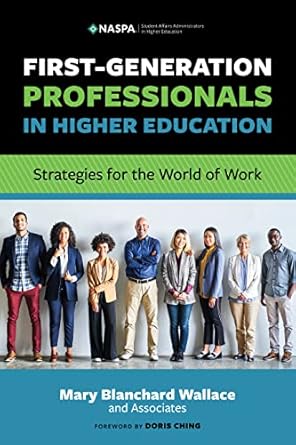
Cover Art First-Generation Professionals in Higher Education by Wallace, Mary Blanchard 

First-generation Professionals in Higher Education: Strategies for the World of Work explores complexities related to the transition from college/professional school to the work world of higher education, as well as the advancement from mid- to senior-level leadership, and how first-generation professionals navigate these transitions. Framing their chapters in the asset-based lens of cultural capital, the authors approach topics of navigating the field of higher education as first-generation professionals through personal experience as well as evidence-based approaches and strategies. Organized in three sections-Professional Identity, Purposeful Interaction, and Career Path--the book examines concepts such as imposter syndrome, politics, financial literacy, resilience, networking, mentoring, career progression, and more. Each chapter includes activities, exercises, and questions for reflection, offering readers an opportunity to discern strategies for their own professional development.
 

Cover Art The hidden curriculum : first generation students at legacy universities by Gable, Rachel 

A revealing look at the experiences of first generation students on elite campuses and the hidden curriculum they must master in order to succeed College has long been viewed as an opportunity for advancement and mobility for talented students regardless of background. Yet for first generation students, elite universities can often seem like bastions of privilege, with unspoken academic norms and social rules. The Hidden Curriculum draws on more than one hundred in-depth interviews with students at Harvard and Georgetown to offer vital lessons about the challenges of being the first in the family to go to college, while also providing invaluable insights into the hurdles that all undergraduates face. As Rachel Gable follows two cohorts of first generation students and their continuing generation peers, she discovers surprising similarities as well as striking differences in their college experiences. She reveals how the hidden curriculum at legacy universities often catches first generation students off guard, and poignantly describes the disorienting encounters on campus that confound them and threaten to derail their success. Gable shows how first-gens are as varied as any other demographic group, and urges universities to make the most of the diverse perspectives and insights these talented students have to offer. The Hidden Curriculum gives essential guidance on the critical questions that university leaders need to consider as they strive to support first generation students on campus, and demonstrates how universities can balance historical legacies and elite status with practices and policies that are equitable and inclusive for all students.
 

Cover Art 33 simple strategies for faculty : a week-by-week resource for teaching first-year and first-generation students by Nunn, Lisa M. 

33 Simple Strategies is designed to offer university faculty simple and straightforward ways they can interact with students both during class time and during office hours that will help mediate some of first-year students' most stressful challenges. The suggested strategies require just 5-15 minutes a week. Every suggestion is rooted in first-year students' own voices, gathered during research at one four-year private and one four-year public institution. The strategies pay particular attention to the additional needs and challenges that low-income, ethno-racial minority, and first-generation college students face in the transition to university academics and college life more generally. Including strategies like Introduce yourself as a person to your students rather than list your professional qualifications, Have students fill out a time log over the course of a week so that you can talk about time management, Help students find study partners among their classmates, All the suggestions came directly from students themselves in one-on-one interviews, where the students described their experiences with professors in and out of the classroom, and articulated things that professors do that they found helpful to their learning, their confidence, and their success, and vice versa as well. For any professor just starting out, or for someone who wants to incorporate techniques to reach first year or first generation students, these short, simple suggestions will prove easy to implement, and will increase student success in any class.
 

Cover Art College belonging : how first-year and first-generation students navigate campus life by Nunn, Lisa M. 

College Belonging reveals how colleges' and universities' efforts to foster a sense of belonging in their students are misguided. Colleges bombard new students with the message to "get out there!" and "find your place" by joining student organizations, sports teams, clubs and the like. Nunn shows that this reflects a flawed understanding of what belonging is and how it works. Drawing on the sociological theories of Emile Durkheim, College Belonging shows that belonging is something that members of a community offer to each other. It is something that must be given, like a gift. Individuals cannot simply walk up to a group or community and demand belonging. That's not how it works. The group must extend a sense of belonging to each and every member. It happens by making a person feel welcome, to feel that their presence matters to the group, that they would be missed if they were gone. This critical insight helps us understand why colleges' push for students simply to "get out there!" does not always work.
 

Cover Art College aspirations and access in working-class rural communities : the mixed signals, challenges, and new language first-generation students encounter by Ardoin, Sonja 

College Aspirations and Access in Working-Class Rural Communities: The Mixed Signals, Challenges, and New Language First-Generation Students Encounter explores how a working-class, rural environment influences rural students' opportunities to pursue higher education and engage in the college choice process. Based on a case study with accounts from rural high school students and counselors, this book examines how these communities perceive higher education and what challenges arise for both rural students and counselors. This book addresses how college knowledge and university jargon illustrate the gap between rural cultural capital and higher education cultural capital. Insights about approaches to reduce barriers created by college knowledge and university jargon are shared and strategies for offering rural students pathways to learn academic language and navigate higher education are presented for both secondary and higher education institutions.

Cover Art Know that you are worthy : experiences from first-generation college graduates 

In Know That You Are Worthy: Experiences from First Generation College Graduates, 31 alumni who were the first in their family to obtain a college degree share their experiences in college. These stories illuminate how the struggles of first generation students are primarily due to a combination of multiple social inequities that are ignored, reinforced, and perpetuated by exclusive college systems. These authors speak directly to current and future first generation students, offering tips and advice for success, along with powerful words of encouragement in their emotionally rich narratives. College faculty and staff are challenged to shift their perspectives from viewing these students from a deficit lens or attempting to make them more like continuing-generation students, to instead having deeply honest confrontations with the pedagogies and structures of college, which are frequently so ingrained that they are invisible, and that cater to continuing-generation students, who are often predominantly white, middle- and upper-class. Colleges can create a more equitable system in which universities are enriched by the wisdom, experiences, and talents of first generation students while promoting a generative culture for all students.
No Subjects